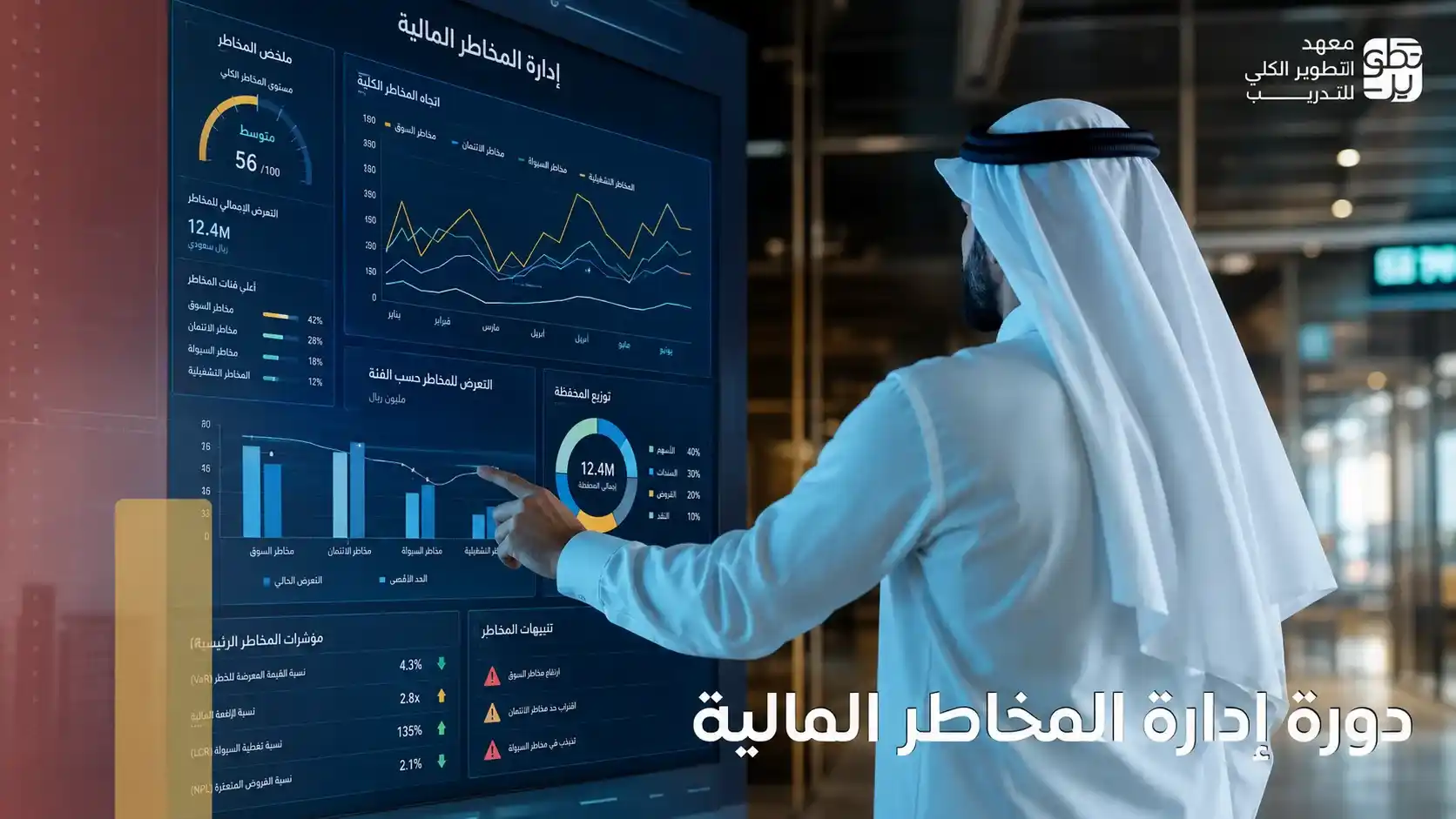
There is no doubt that our world today has become an unstable economic arena where numbers change rapidly, markets fluctuate between risks and opportunities in moments, and here emerges the critical role of experts who can read the future and make informed decisions that protect institutions from losses. This is the world that the Financial Risk Management Course prepares you for a course that has become one of the most powerful professional tools for financial managers, project managers, consultants, and anyone working in environments that require precise, scientifically based decisions.
In this article, we explore the core concepts of the Financial Risk Management Course, its importance in protecting businesses, the real difference between it and Crisis Management, how they complement each other, the skills you gain, the strong relationship between risk and crisis management in maintaining organizational balance, the most in-demand career fields for this specialization, and finally, how to choose the right course for your career path. If you aspire to elevate your professional skills and build a strong ability to face financial risks and make confident decisions, keep reading.
What is the Financial Risk Management Course?
The Financial Risk Management Course is one of the most important training programs designed to empower professionals with the ability to understand the risks facing financial institutions and companies of all types. It combines theory with practical application, enabling participants to identify risks, analyze them, and develop effective strategies to protect assets and ensure organizational stability.
With increasing economic volatility and growing complexity in financial markets, this course has become essential for those working in investment, project management, accounting, and governance. It enhances organizational risk awareness, teaches precise environmental risk analysis, and applies the latest global best practices in qualitative and quantitative analysis tools. Upon completion, participants become capable of making more informed and professional decisions that strengthen the institution and significantly reduce the likelihood of financial losses.
Importance of the Financial Risk Management Course
No institution today whether banking, governmental, or commercial can survive without an effective risk management system. This is where the importance of enrolling in a Financial Risk Management Course becomes clear. The course goes beyond mere risk analysis; it builds a strategic mindset based on anticipation, prevention, and calculated response. Key benefits include:
- Raising financial awareness within the organization and enabling employees to make accurate decisions.
- Enhancing the organization’s ability to predict risks before they occur and minimize their negative impact.
- Supporting governance and increasing transparency in risk assessment.
- Improving the organization’s resilience during global economic changes.
- Empowering managers to develop effective, priority-based response plans.
With these advantages, the Financial Risk Management Course becomes a fundamental element in developing competencies, especially for those aiming to build a strong career in financial analysis and crisis management. Obtaining a professional certification in risk management is highly recommended.
Difference Between Financial Risk Management and Crisis Management – And How They Complement Each Other
Many confuse Financial Risk Management with Crisis Management, but they are distinct yet complementary fields. The Financial Risk Management Course focuses on proactively analyzing potential risks and developing plans to prevent or mitigate them, while Crisis Management deals with sudden events that have already occurred and require immediate intervention.
However, integration between the two is essential. An organization with a strong risk management system can respond faster and more effectively when a crisis hits. The relationship can be summarized as follows:
- Risk Management focuses on anticipating, analyzing, and assessing threats before they materialize.
- Crisis Management focuses on direct handling of emergencies.
- An effective risk plan makes crisis response faster and less costly.
- Accurate financial analysis helps determine the crisis impact and make correct decisions.
Combining both courses gives professionals a comprehensive view of protecting the organization from internal and external threats.
What Do You Learn in Financial Risk Management Courses?
The Financial Risk Management Course offers rich, practical content that helps participants acquire multiple professional skills using modern digital tools for data analysis and decision-making. Key topics include:
- Identifying types of financial risks: market risk, credit risk, operational risk, liquidity risk.
- Conducting qualitative risk analysis using:
- Brainstorming
- Delphi technique
- SWOT analysis
- Heat maps
-
Performing quantitative risk analysis using:
- Value at Risk (VaR)
- Stress testing
- Monte Carlo simulation
- Scenario analysis
- Using risk-adjusted performance metrics.
- Understanding governance and compliance in building effective risk management systems.
- Creating comprehensive risk registers for early warning monitoring.
These skills give participants strong decision-making capabilities, making the course a true investment in their professional future.
The Relationship Between Crisis Management and Financial Risk Management Courses in Protecting Businesses
The Crisis Management course plays a pivotal role in business continuity by managing sudden events that threaten stability. Meanwhile, the Financial Risk Management Course serves as the preventive path that either prevents crises or reduces their impact. When combined, organizations build an integrated protection system based on:
- Early crisis anticipation.
- Accurate financial impact analysis of potential threats.
- Preventive plans and calculated responses.
- Data-driven decision-making.
- Building a risk-aware culture within the organization.
This strong interconnection enables professionals to fully understand the crisis lifecycle from preceding risks to effective control.
Career Fields That Most Need Skills from Financial Risk Management Courses
Many sectors now rely heavily on professionals trained in Financial Risk Management due to the sensitivity and long-term impact of financial decisions. The most in-demand fields include:
- Banks and financial institutions
- Investment and portfolio management companies
- Insurance companies
- Large corporations with long-term projects
- Oil and energy sector
- Government and regulatory bodies
- Technology and digital transformation companies
- Financial consulting firms
Professionals in these fields benefit from precise data analysis, risk forecasting, and robust planning to protect financial resources, making them essential to organizational growth.
How to Choose the Best Financial Risk Management Course for Your Career Path?
To select the best Financial Risk Management Course, consider the following key factors:
- Assess your current experience level and the skills you need to develop.
- Clarify your goal: promotion, career change, or acquiring specific skills.
- Ensure the course covers both qualitative and quantitative analysis comprehensively.
- Choose a course that emphasizes practical application and real-world examples.
- Verify the training provider’s accreditation and the trainers’ expertise.
- Confirm availability of analytical tools and reports for real-world application.
By considering these points, choosing the right course becomes easier and perfectly aligned with your professional goals.
ConclusionEnrolling in a Financial Risk Management Course is not just a training step it’s a conscious leap toward higher professionalism in analysis and decision-making. In an era of expanding challenges and volatile markets, organizations need experts who can assess risks, interpret numbers intelligently, and handle financial threats with confidence.
With the professional financial and management programs offered by the MDIT, you can build a solid skill foundation that supports your career and gives you greater confidence in facing challenges.
Don’t wait for risks to occur before you prepare start now. Contact the MDIT and elevate your professional skills toward a more stable and distinguished future.
Frequently Asked Questions
Is the Financial Risk Management Course suitable for beginners?
Yes, beginners with basic financial knowledge can join. The curriculum starts with fundamentals and gradually progresses to advanced qualitative and quantitative analysis, making it ideal for those starting out or switching careers.
What is the difference between Crisis Management and Financial Risk Management courses?
Crisis Management focuses on handling emergencies after they occur, while Financial Risk Management focuses on predicting, analyzing, and preventing risks before they happen. The two complement each other perfectly: one provides control, the other prevention and early detection.