General Description
Training on the Key Performance Indicators (KPIs) Certificate gives you a distinguished professional opportunity to develop your skills in performance measurement and results analysis, and to transform organizations’ goals into clear and measurable indicators that help improve decisions and enhance work efficiency.
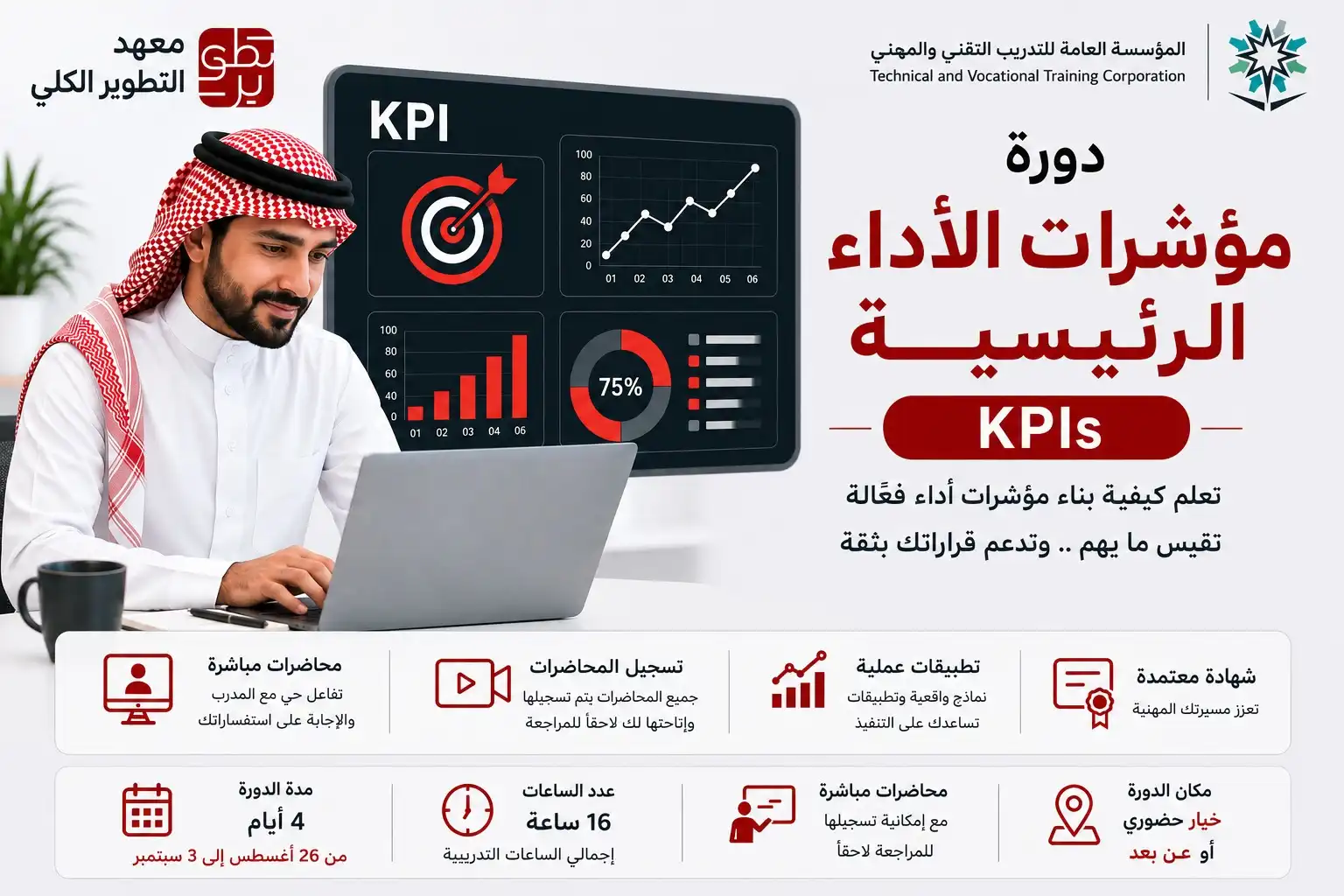
The training on the Key Performance Indicators (KPIs) Certificate helps the trainee understand the fundamentals of performance measurement, design effective indicators, analyze data, and link results to strategic objectives in order to make more accurate decisions and improve work efficiency within organizations. The program is also available fully online for 4 days with a total of 16 training hours, providing you with flexibility in learning while benefiting from practical and focused training content.
With a cost is 4,999 Saudi Riyals (approximately equivalent to 1,333 US Dollars), it is a suitable opportunity to acquire a required administrative skill and develop your professional abilities before the price changes or available seats are completed.
Contact the team of the Total Development Institute now, reserve your place, and begin your journey toward mastering performance management and measurement, and developing your skills in line with the requirements of the labor market in the Kingdom of Saudi Arabia.
The Goals
Objectives of the Training on the Key Performance Indicators (KPIs) Certificate
The Training on the Key Performance Indicators (KPIs) Certificate program aims to provide trainees with the knowledge and skills that help them apply performance measurement methodologies within organizations. The most important objectives of the program include:
- Learning how to design Key Performance Indicators (KPIs) that help measure quality, productivity, development, and institutional sustainability.
- Acquiring the ability to collect and analyze data and set clear targets for performance indicators.
- Recognizing the role of effective performance indicators in evaluating organizational performance and measuring the extent to which required results are achieved.
- Understanding methods of analyzing financial, operational, and market performance indicators to support administrative decisions.
- Preparing a practical plan to implement a Key Performance Indicators (KPIs) system within organizations.
The Training on the Key Performance Indicators (KPIs) Certificate helps participants move from traditional performance monitoring to using a professional methodology based on measurement, analysis, and continuous improvement. Develop your performance measurement expertise with the Total Development Institute and be prepared for modern management requirements within the Kingdom.
Target Auidence
Target Groups for the Training on the KPIs Certificate
The Training on the Key Performance Indicators (KPIs) Certificate program has been designed to suit a wide range of employees in different sectors. The main beneficiary groups include:
- Employees in the educational, healthcare, and administrative sectors.
- Human resources managers and job performance development specialists.
- Quality, excellence, and organizational development specialists.
- Project managers and work team supervisors.
- Managers and leaders responsible for planning and strategic decision-making.
- Employees working in the fields of performance management, strategic planning, and Balanced Scorecards.
- Business analysts and managers who wish to develop their performance analysis skills.
- Executive managers and heads of various departments and administrations.
- Planning, follow-up, and reporting teams.
- Entrepreneurs and owners of small and medium-sized enterprises.
Join the Total Development Institute and obtain training that helps you develop your professional capabilities in performance management within Saudi Arabia.
The Features
Advantages of the Training on the Key Performance Indicators (KPIs) Certificate
The Training on the Key Performance Indicators (KPIs) Certificate program provides an integrated training experience that combines theoretical knowledge with practical application. The most important advantages include:
- Training exercises and projects to develop analysis skills and solve performance-related problems.
- Studying practical cases that demonstrate how to apply KPIs in different sectors and fields.
- Continuous guidance and support to help trainees understand concepts and apply them correctly.
- Interactive training based on modern methods that support understanding, discussion, and experience sharing.
- Developing the professional skills required to improve performance management within Saudi organizations.
- Practical applications and workshops that help trainees use performance indicator concepts in real-life situations.
- Practical training content that helps in using performance indicators directly within the work environment.
Topics
Training Topics for the Key Performance Indicators (KPIs) Certificate
The training program focuses on a set of basic topics that help trainees understand the lifecycle of performance indicators, starting from design until analysis and improvement.
Unit One: Fundamentals of Performance Measurement and KPIs
- The difference between performance measurement and performance management.
- The concept of Key Performance Indicators (KPIs) and their importance.
- The role of KPIs in achieving organizational goals and strategies.
- Types and levels of performance indicators: strategic indicators, operational indicators, and individual indicators.
- Stages of building and managing a performance indicator from design to improvement.
Unit Two: Designing and Building Performance Indicators
- Gap analysis and measuring the level of progress toward goals.
- The difference between outcome indicators and activity indicators.
- Standards for selecting effective indicators according to the SMART methodology.
- Steps for identifying and selecting appropriate performance indicators.
- The difference between quantitative indicators and qualitative indicators.
Unit Three: Balanced Scorecard and Linking Indicators to Strategy
- Building strategic maps and linking them to indicators.
- Linking Key Performance Indicators (KPIs) to the organization’s vision and mission.
- The concept of the Balanced Scorecard and its importance.
- Practical applications for designing performance scorecards.
- Learning about the four dimensions of the Balanced Scorecard: internal processes, learning and growth, financial perspective, and customers.
- Building strategic maps and linking them to indicators.
Unit Four: Data Collection and Performance Indicator Analysis
- Identifying the data sources used in performance measurement.
- Methods of collecting and analyzing data related to indicators.
- Preparing performance monitoring dashboards.
- Using technical tools such as Excel, Power BI, and Google Data Studio.
- Analyzing results and identifying appropriate corrective actions.
Unit Five: Applications of KPIs in Different Fields
- Performance indicators in Human Resources Management.
- Performance indicators in Marketing and Sales.
- Performance indicators in Customer Service.
- Performance indicators in Education, Healthcare, and Manufacturing.
- Applying practical cases on the use of KPIs.
Unit Six: Challenges of Implementing a Performance Indicators System
- Linking KPIs with development and motivation.
- Ensuring the continuity and improvement of the performance measurement system.
- Dealing with inaccurate data or ineffective indicators.
- Addressing employee resistance to performance measurement systems.
- Common mistakes when designing performance indicators.
Start your learning journey with the Total Development Institute and acquire KPIs application skills in line with the needs of organizations in the Kingdom.
Learning outcomes
Skills Acquired After the KPIs Certificate Training
After completing the Training on the Key Performance Indicators (KPIs) Certificate program, the trainee will be able to:
- Understand the fundamentals and concepts of Key Performance Indicators.
- Link indicators to the organization’s goals and strategies.
- Transform plans and objectives into measurable indicators.
- Select appropriate performance indicators for each administrative level.
- Distinguish between operational, strategic, and tactical indicators.
- Design performance monitoring dashboards.
- Analyze performance data and extract appropriate decisions.
- Use Key Performance Indicators (KPIs) in evaluating and improving employee performance.
- Prepare professional performance reports.
- Improve organizational efficiency through implementing effective measurement systems.
- Select indicators that help achieve better business results.
Requirements And Conditions
Requirements for the Training on the Key Performance Indicators (KPIs) Certificate
The Training on the Key Performance Indicators (KPIs) Certificate program does not require complicated requirements for joining. It is suitable for professionals who wish to develop their skills, with the importance of having:
- Passing the program’s evaluation or test in order to obtain the certificate.
- Commitment to attending the entire training program.
- Preferably having practical experience of no less than two years to benefit more from practical applications.
The program combines the theoretical and practical aspects to provide the trainee with a real ability to use Key Performance Indicators in improving organizational performance and making more accurate decisions within the work environment.
Contact the Total Development Institute now and obtain the Key Performance Indicators (KPIs) Certificate training and start developing your skills in performance management and measurement within the Kingdom.
FAQs
The Blog
The Training on the Key Performance Indicators (KPIs) Certificate is a training program that helps you understand the fundamentals of performance measurement and how to use indicators in developing and improving organizations’ results.
During the training, you will learn how to design effective performance indicators, analyze data, and link results to strategic objectives to make more accurate decisions.
The program is suitable for managers, professionals, entrepreneurs, and anyone who wishes to develop their skills in performance management and achieve better results in the workplace.
Start your professional journey now and obtain the Key Performance Indicators (KPIs) Certificate training with the Total Development Institute in the Kingdom of Saudi Arabia, and develop your skills in performance management and measurement.
Details of the KPIs Certificate Training
The evaluation stage in the KPIs Certificate includes an electronic test aimed at measuring the trainee’s understanding of the concepts and skills covered during the program. The test details include:
- Test Language: The test is provided in Arabic to facilitate understanding of the questions and answering them.
- Number of Questions: The test consists of 30 questions to evaluate knowledge of concepts and applications related to performance indicators.
- Test Duration: The allocated time to complete the test is 90 minutes.
- Passing Score: A score of no less than 70% is required to pass the test and obtain the certificate.
- Question Format: The test is based on various types of questions, including multiple-choice questions and true/false questions.
- Test Delivery Method: The test is conducted electronically (online), providing flexibility and ease for trainees.
- Training Duration and Method: The program is delivered online for 4 training days with a total of 16 training hours, combining theoretical content and practical applications.
Cost of the Key Performance Indicators (KPIs) Certificate for 2026
The KPIs Certificate is considered one of the important professional programs for anyone who wants to develop skills in performance measurement and results analysis, and transform organizational goals into measurable indicators, especially with the increasing reliance of entities in the Kingdom of Saudi Arabia on performance management systems and strategic planning to improve decision quality.
The cost of the Key Performance Indicators Certificate is 4,999 Saudi Riyals (approximately equivalent to 1,333 US Dollars), which is a suitable value compared to the practical skills gained by the trainee in designing performance indicators, analyzing data, and building reports and monitoring dashboards that help improve organizational efficiency.
Start now with the Total Development Institute and reserve your seat to obtain professional training in Key Performance Indicators (KPIs) for 2026, and develop your professional capabilities in line with the requirements of the labor market in the Kingdom of Saudi Arabia.
Granting Bodies for the Key Performance Indicators (KPIs) Certificate
The certificate-issuing body is one of the most important factors that enhances the value and credibility of any professional program, especially in the field of performance management and results measurement. Professional certifications provide trainees with a global framework to develop their skills and improve their career opportunities. The organization associated with the certificate includes:
-
KPI Institute: A global organization specialized in developing Key Performance Indicators (KPIs) standards and practices. It provides professional certifications and training programs aimed at qualifying specialists in designing, measuring, and analyzing performance indicators and linking them to the strategic objectives of organizations.
Contact Total Development Institute to learn more about the Key Performance Indicators (KPIs) Certificate, registration requirements, and the steps to obtain a professional certification that helps you develop your skills in performance management and measurement within the Kingdom of Saudi Arabia.
Tips for Test Applicants for the Key Performance Indicators (KPIs) Certificate
To ensure good preparation for the KPIs Certificate test and achieve the best result, it is important to review the basic concepts and focus on the practical aspects that help you understand and apply performance indicators efficiently.
- Reviewing the basics of KPIs and understanding their role in measuring and improving organizational performance.
- Learning about the types of indicators, including strategic, operational, and individual indicators.
- Understanding the standards for designing KPIs and linking them to organizational objectives.
- Reviewing the Balanced Scorecard and its most important applications.
- Practicing sample questions to become familiar with the nature of the test.
- Reviewing the training content and focusing on the basic concepts.
- Managing test time effectively and reading questions carefully.
- Focusing on the practical application of performance indicators rather than memorization only.
Start your training now with the Total Development Institute and obtain the KPIs Certificate that supports your professional development in the Saudi labor market.